


The SYN43756E chip from Synaptics is a high-performance Wi-Fi 6E IoT (Internet of Things) SoC that supports 11a/b/g/n/ac/ax standards. It features multiple advanced capabilities and is suitable for a wide range of application scenarios. Below are its key advantages:
1. Wide range of application scenarios
Smart Home: Supports multiple wireless protocols, compatible with devices such as tablets, smart speakers, smart bulbs, and smart cameras.
Industrial Internet of Things: Supports high reliability and low-latency communication, suitable for industrial automation and monitoring systems.
Automotive Electronics: Providing high bandwidth and low latency connectivity, suitable for in-vehicle entertainment and communication systems.
2. Multi-band support and high-performance wireless connectivity
Tri-band Wi-Fi 6E: Supports 2.4GHz, 5GHz, and 6GHz bands, offering higher bandwidth and lower latency, ideal for high-density network environments.
Bluetooth 5.3/5.4: Supports the latest Bluetooth standards, offering longer transmission distances and higher data transfer rates, suitable for low-power devices.
Optional 802.15.4 radio: Supports Zigbee and Thread protocols, suitable for smart home and industrial IoT applications.
3. High integration and low power consumption design
Simultaneous Dual-Band (DSDB) Operation: Allows devices to connect to two different Wi-Fi bands simultaneously, enhancing network efficiency and user experience.
Low-power design: Suitable for battery-powered devices such as wearables and smart sensors, extending the device's battery life.
4. Support for AI-native computing platforms
Synaptics Astra Platform: Built-in support for Synaptics Astra simplifies the development of edge AI products, offering contextual awareness features suitable for smart home, automotive, and enterprise applications.
5. Rich interfaces and compatibility
SDIO 3.0 and PEIC 3.0 interfaces: Provide high-speed data transfer, suitable for communication with external host chips.
Operating system support: Compatible with Linux and Android systems, making development and integration convenient.
6. Simplify development and testing
RF Test Support: Provide detailed RF RX non-signaling test procedures to facilitate developers in performance verification and optimization.
Dual firmware design: Supports the AP firmware for regular use and the mfgtest firmware for RF testing, facilitating development and testing.
Summary
The Synaptics SYN43756E chip, with its multi-band support, high integration, low power consumption design, AI-native computing platform support, and extensive interfaces and compatibility, has become an ideal choice for IoT applications. Its wide range of application scenarios and simplified development process further enhance its competitiveness in the market.
Here are 5 frequently asked questions (FAQs) about the Synaptics SYN43756E chip, compiled from relevant technical documents and testing guidelines:
Q1: Which operating systems does SYN43756E support?
A1: SYN43756E supports Linux and Android operating systems. Its interface design and driver compatibility are primarily tailored for these two systems, making it convenient for IoT device development. Users can perform debugging and testing in a Windows environment using the ADB tool.
Q2: How do I load the mfgtest firmware for RF testing?
A2: There are two methods to load the mfgtest firmware:
Firmware update method: Replace the default firmware file via ADB commands and restart the device.
Temporary loading method: Use the `insmod` command to directly specify the firmware path without permanently replacing it.
Both methods require ensuring that the path and name of the firmware file are correct.
Q3: How can I verify if the device is properly connected?
A3: After connecting the device to the computer via USB, if the Device Manager can recognize the device (e.g., displayed as SYN43756E), it indicates that the USB communication and hardware status are normal. This step is a prerequisite for subsequent RF testing.
Q4: Does the RF of SYN43756E support adjustment?
A4: 2.4 GHz and 5/6 GHz, BT both support RF tuning through the chip's NVRAM and HCD firmware.
Q5: How to test the reception sensitivity of 5G/6G frequency bands?
A5: It is necessary to reconfigure the RX parameters (such as frequency band, antenna selection, channel, etc.) via ADB, then send 1,000 data packets and check the number of packets received. The testing process is similar to that of 2.4GHz, but you must ensure the parameters are switched to the corresponding frequency band and bandwidth settings for 5G/6G.
►场景应用图

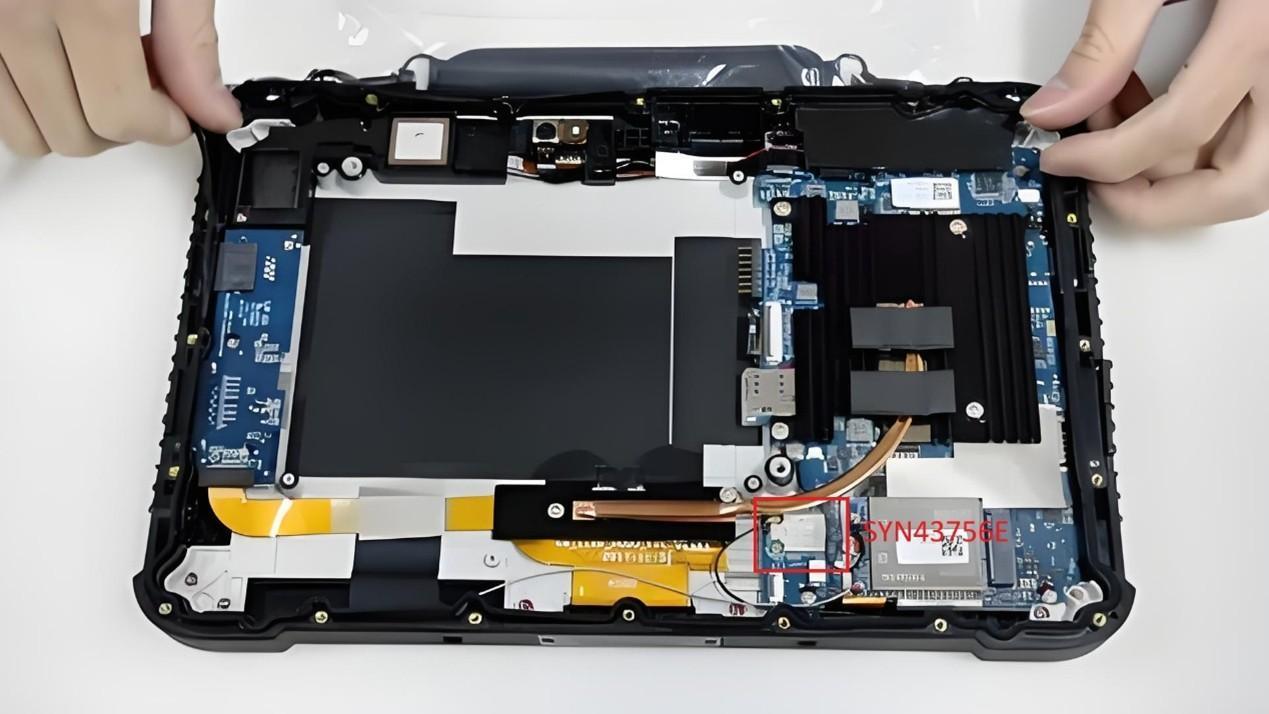
►产品实体图
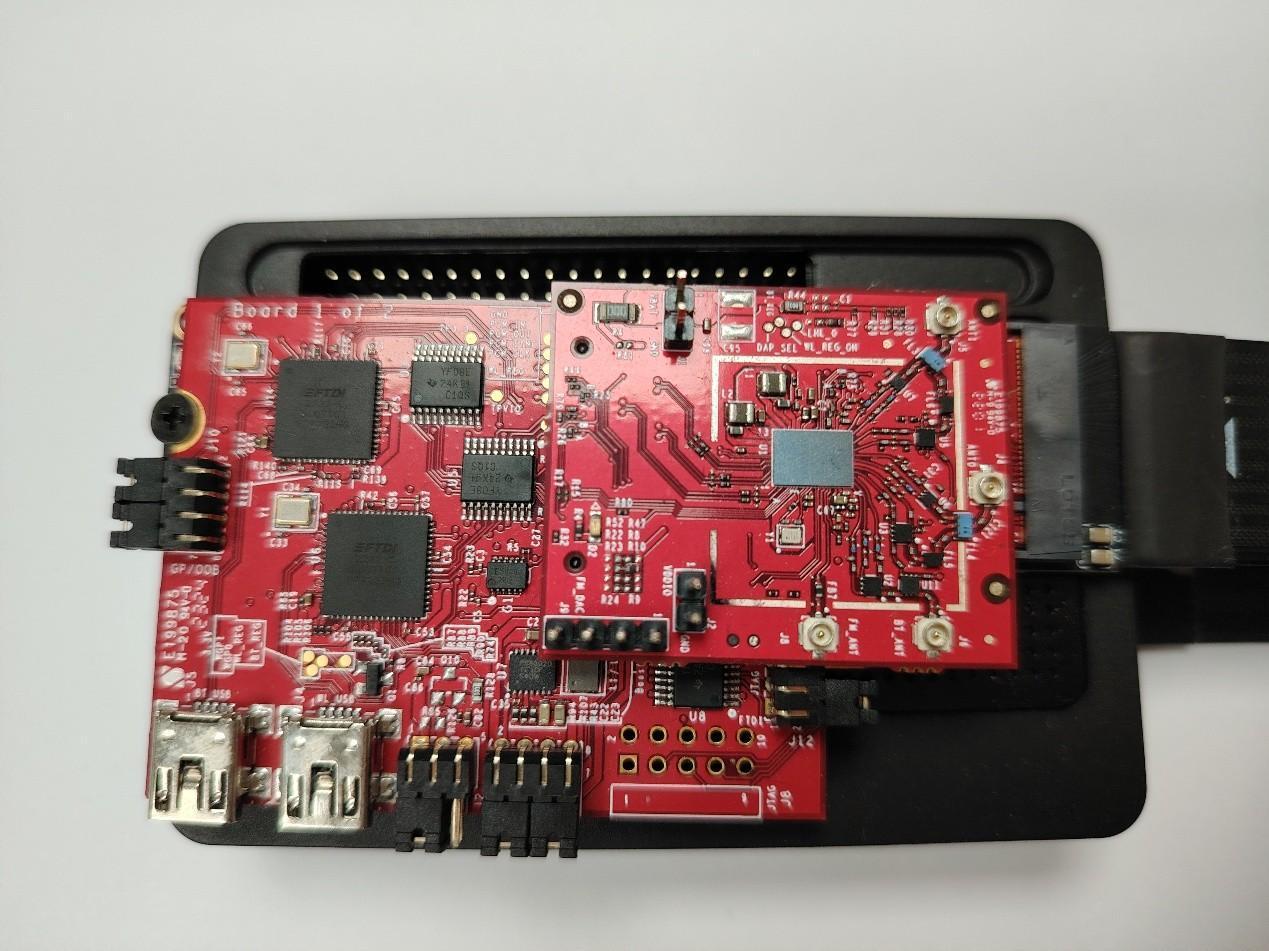
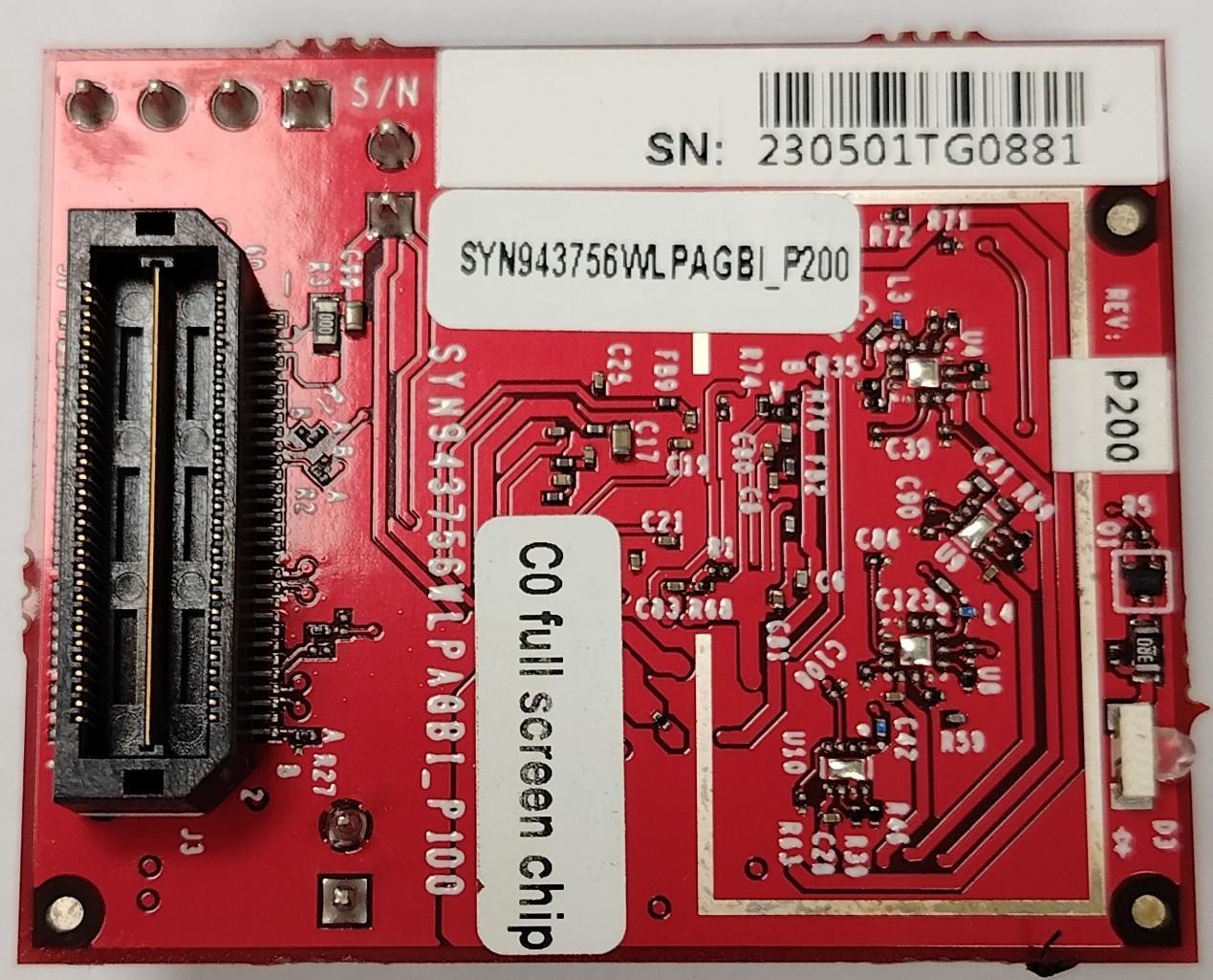
►展示板照片
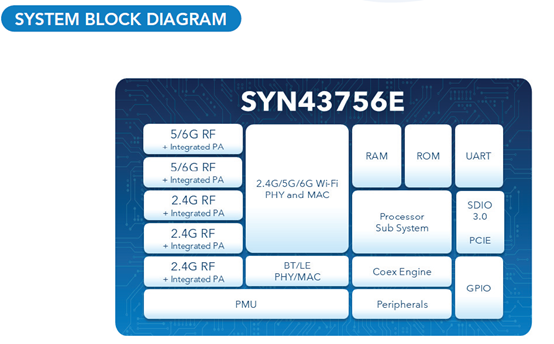
►方案方块图
►核心技术优势
► Wi-Fi 6E standard, supporting more client connections with improved stability ► Small package size, low cost, low power consumption, low complexity, and short product launch cycle ► Capable of operating simultaneously on 2.4 GHz and 5/6 GHz bands, with throughput up to 1200 Mbps ► Supports multiple concurrent Bluetooth connections and audio streaming ► Advanced Wi-Fi/Bluetooth coexistence technology ► Seamless network interoperability ► Rich human-machine interfaces, such as SDIO/PCIE, UART
►方案规格
► Supports Wi-Fi 2.4/5/6 with advanced CMOS RF, including integrated PA and LNA (optional external PA and LNA), delivering maximum transmit (Tx) power levels and receive (Rx) sensitivity; capable of operating 1024QAM within a 10-meter range ► Compliant with IEEE 802.11ax standard; backward compatibility with 802.11a/b/g/n; supports Wi-Fi 6E ► 2 x 2 MIMO antenna array ► Supports LE audio ► Integrated Bluetooth 5.3 with support for Bluetooth Low Energy (BLE) ► Dedicated Bluetooth antenna ► Built-in Bluetooth PA with two modes: normal output power mode (14 dBm) and high output power mode (20 dBm) ► Supports interfaces such as PCIE V3.0, SDIO 3.0, 4-wire UART, PCM/I2S, JTAG, etc.