


The Rise of the Smart Wave: The Era of AI and Edge Computing—AI and edge computing are quietly integrating into our daily lives, from popular language models like ChatGPT and DeepSeek to Meta's smart glasses.
However, as AI applications continue to expand, traditional cloud computing is gradually encountering bottlenecks in terms of real-time performance, privacy protection, and bandwidth. This challenge is particularly evident in high-precision applications such as autonomous driving, smart healthcare, and industrial automation, where millisecond-level delays can lead to critical decision-making errors. As a result, edge computing has emerged, enabling data processing closer to the source and establishing a lower-latency, more secure, and more efficient AI computing model.
The core driving force behind this shift is the development of Neural Processing Units (NPUs), which empower compact devices with enhanced computational capabilities. This advancement reduces data transmission latency and costs while improving privacy security, allowing AI to be deployed across a broader range of scenarios.
The core driving force behind this transformation is the advancement of Neural Processing Units (NPUs), which empower compact devices with greater computational power, lower data transmission latency and costs, and enhance privacy and security. This enables AI to be deployed across a broader range of applications.
The Rise of Visual AI: Key Applications Transforming the World—From medical diagnostics to autonomous driving, visual AI is rapidly expanding its reach, fundamentally reshaping the operational models of various industries.
The following isThe important applications of AI in the field of vision:
- Intelligent Surveillance: Intelligent Surveillance involves real-time target detection, behavior analysis, and intrusion alerts to enhance urban safety and monitoring systems.
- Smart Retail: Enhance the shopping experience and optimize sales strategies through customer behavior analysis and intelligent shelf management.
- Medical Image Analysis: Utilizing AI to assist doctors in disease diagnosis, such as tumor detection and lesion identification, to enhance medical accuracy.
- Industrial Quality Inspection: Automating the detection of product defects to enhance quality control and production efficiency in manufacturing.
- Advanced Driver Assistance Systems (ADAS): Utilizing AI to process visual information, analyze road environments, pedestrians, and obstacles, enhancing driving safety and decision-making capabilities.
- Agricultural Monitoring: Through AI vision technology, farmers can monitor crop health, detect pests and diseases, optimize agricultural management, and improve yield and quality.
- Autonomous Mobile Robots (AMRs): Autonomous mobile robots utilize AI technology, leveraging sensors and algorithms to navigate independently and avoid obstacles. They are applied in various scenarios such as logistics and inspections.
- Robotic Arms: In the manufacturing industry, robotic arms integrated with AI and vision systems can precisely perform tasks such as assembly and welding, enhancing production efficiency and product quality.
- Automated Food Delivery Systems: Delivery platforms like Uber Eats are deploying food delivery robots developed by Serve Robotics in multiple cities across the United States. These robots are equipped with AI technology, enabling them to autonomously navigate to customers' locations and provide efficient food delivery services.
- Drone Image Analysis: AI-powered vision systems enable drones to perform terrain mapping, disaster assessment, and infrastructure inspection, providing efficient data collection and analysis.
When AI is integrated with edge computing technology, these applications will become more efficient, more reliable, and better suited to real-world needs. The future will be an era of digital intelligence and seamless connectivity, where AI is not just a technology but a pivotal force driving industrial transformation and human progress.

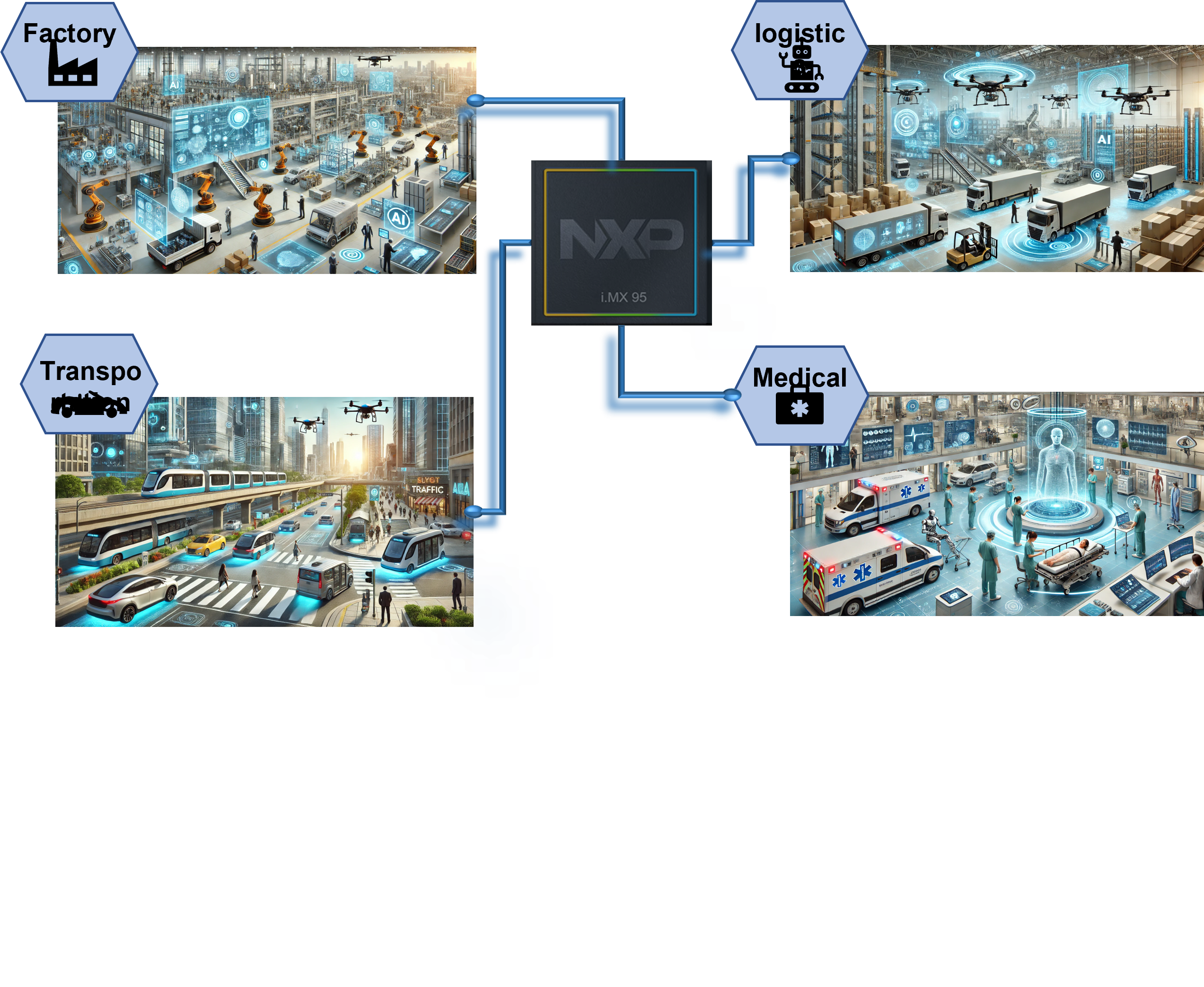
Figure 1: i.MX95 EVM Board Application Scenarios
NXP's i.MX 95 applications processor series, featuring a powerful multi-core architecture, provides a robust foundation for high-performance and real-time applications. Equipped with six Arm® Cortex-A55 cores, one Arm Cortex-M7 core, and one Arm Cortex-M33 core, this processor series delivers exceptional performance across application-level, system-level, and real-time processing domains.
To further enhance the efficiency of artificial intelligence (AI) applications, the i.MX 95 series integrates NXP's eIQ® Neutron Neural Processing Unit (NPU), delivering up to 2 TOPS (Tera Operations Per Second) of computational power. This significantly reduces inference time—for instance, when running the widely used object detection model YOLOv5, it takes only about 5 milliseconds (ms) to process a single image and complete recognition, demonstrating exceptionally high computational speed.
In addition, the i.MX 95 series is equipped with an advanced Image Signal Processor( ISP) and 2D/3D Graphics Processing Units (GPUs), supporting 4K resolution decoding at 60 frames per second. These features enable efficient processing of traditional tasks such as image scaling, format conversion, and video decoding, ensuring optimized video streaming performance.

Figure 2: i.MX 95 Block Diagram Illustration
Source of text and images: NXP official website
The i.MX 95 application processor series offers a rich set of I/O interfaces, allowing users to connect a wide range of peripheral devices to meet diverse application needs. The supported interfaces include:
- MIPI-CSI: Supports multiple camera connections (up to 8 channels), suitable for high-resolution image capture, meeting the needs of advanced image processing and machine vision applications.
- Ethernet Interface: Equipped with one 10GbE and two Gb Ethernet interfaces, supporting Time-Sensitive Networking (TSN), Audio Video Bridging (AVB), and IEEE 1588 synchronization protocol to ensure high-speed and precise data transmission. It is suitable for applications requiring high reliability and low latency, such as industrial automation and in-vehicle networks.
- USB Interface: Provides one USB 3.0 Type-C and one USB 2.0 Type-C interface, supporting high-speed data transfer and various external devices, enhancing the system's expandability and flexibility.
- CAN FD Interface: Equipped with 5 CAN FD interfaces, suitable for vehicle and industrial control systems, providing reliable communication capabilities, supporting higher data rates and more efficient data transmission.
- Serial communication interface: Supports 8 UARTs, 8 I²C, 8 SPI, and 2 I3C interfaces, offering a variety of communication options for easy connection with various sensors, actuators, and other peripheral devices.
- Analog-to-Digital Converter (ADC): Includes one 8-channel, 12-bit ADC, suitable for precise analog signal measurements such as sensor data acquisition and monitoring applications.
- FlexIO Interface: Provides two 32-pin FlexIO interfaces that can be configured as communication interfaces such as UART, SPI, I²C, and I²S, enhancing system design flexibility to meet specific application requirements.
- PCIe Interface: Equipped with 2 PCIe Gen 3 lanes, supporting high-speed data transfer and expansion, suitable for connecting high-performance peripherals such as high-speed storage devices and network cards.
- MIPI-DSI Display Interface: Supports up to 350 MHz MIPI-DSI with a four-lane configuration, offering a data transfer rate of 2.5 Gbps per lane. It enables display output at 4K resolution (30 frames per second) or 3840x1440 resolution (60 frames per second), meeting the requirements for high-resolution displays.
- LVDS Display Interface: Supports LVDS transmission up to 1080p@60fps, configurable as 2 sets of 4 channels or 1 set of 8 channels, providing flexible display interface options to meet various display application needs.
This plan showcases module inference performance using an AI camera or AI industrial computer based on the i.MX 95. It integrates multiple core technologies, including a Neural Processing Unit (NPU), a Graphics Processing Unit (GPU), and an Image Signal Processor (ISP), enabling outstanding performance in artificial intelligence (AI) and image processing applications.
Implement multiple AI functionalities, including
- Object Detection : Identifying and locating various objects in an image.
- Pose Estimation : Analyzing human posture and tracking key point positions.
- Object Segmentation : Separating objects in an image from the background.
- Construction Helmet Detection : Ensure workers are wearing safety helmets.
- Vehicle Detection : Identify and track vehicles.
- Mask Detection : Determine whether individuals are wearing masks.
- Fruit Detection : Identifying different types of fruits.
- Human Keypoint Detection : Locating key points of the human body.
- Hand Skeleton Detection : Tracking the positions of hand joints.
- Depth Estimation : Estimating the distance between objects in an image and the camera.
Due to the high performance of the i.MX 95 processor, the system can process images at a speed of 30 frames per second (FPS) while utilizing only a single CPU core. This significantly reduces the computational load on the CPU, making it well-suited for most edge computing applications.

Figure 3: i.MX 95 AI DEMO Diagram
NXP has demonstrated remarkable progress in advancing artificial intelligence (AI) computing platforms. Through eIQ can quickly apply deep learning frameworks such as TensorFlow, TensorFlow Lite, ONNX, Keras, and more. As shown in the figure below, you only need to delegate the corresponding data, such as images and audio, to any deep learning framework for inference. This allows for the rapid analysis of the neural network architecture to obtain results. Additionally, the framework will optimize accelerated computation through the Neutron Delegate. Based on actual testing,YOLOv5s object detection, with an inference speed of approximately 190 FPS (frames per second).。

Figure 4: Illustration of NXP I.MX95 EVK Deep Learning Application
From the i.MX 8M Plus and i.MX 93 to the latest i.MX 95 series, there has been a significant improvement in performance, especially in common AI applications such as object detection, with a substantial increase in processing speed. Even in under the condition of similar physical specifications that the neural processing unit (NPU) of the i.MX 95 has a faster computation speed compared to the i.MX 8M Plus. Increased nearly fourfold。

Figure 5: i.MX 95 AI Performance Diagram
The i.MX 95 series processors not only feature powerful computing capabilities but also offer a rich and diverse array of I/O interface configurations. This enables developers to flexibly connect various peripherals, meeting the needs of different application scenarios while providing a high degree of design freedom and scalability. In practical applications, these processors demonstrate exceptional flexibility and can be widely used in fields such as the Internet of Things (IoT), Industry 4.0, and autonomous vehicles. Fully realize the concept of edge computing and create greater application value.。
Additionally, NXP provides developers with powerful tools to help them implement AI capabilities in various innovative applications.
- eIQ® Toolkit for End-to-End Model Development and Deployment
- eIQ® Model Watermarking Technology
- eIQ Example
- eiq-model-zoo
- nxp-nnstreamer-examples
- GUI Guider
- AI DEMO by WPI offer
- ATU_Model_Zoo by WPI offers
►场景应用图
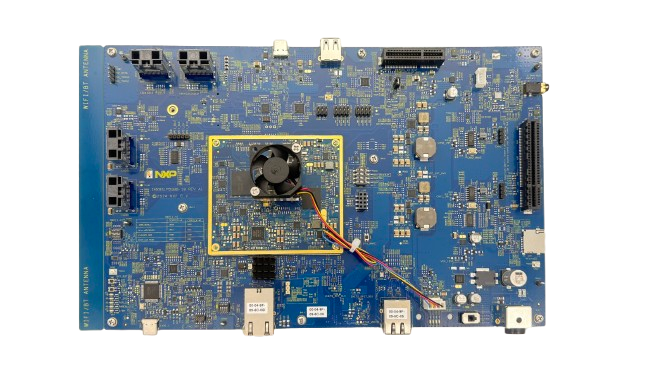
►展示板照片
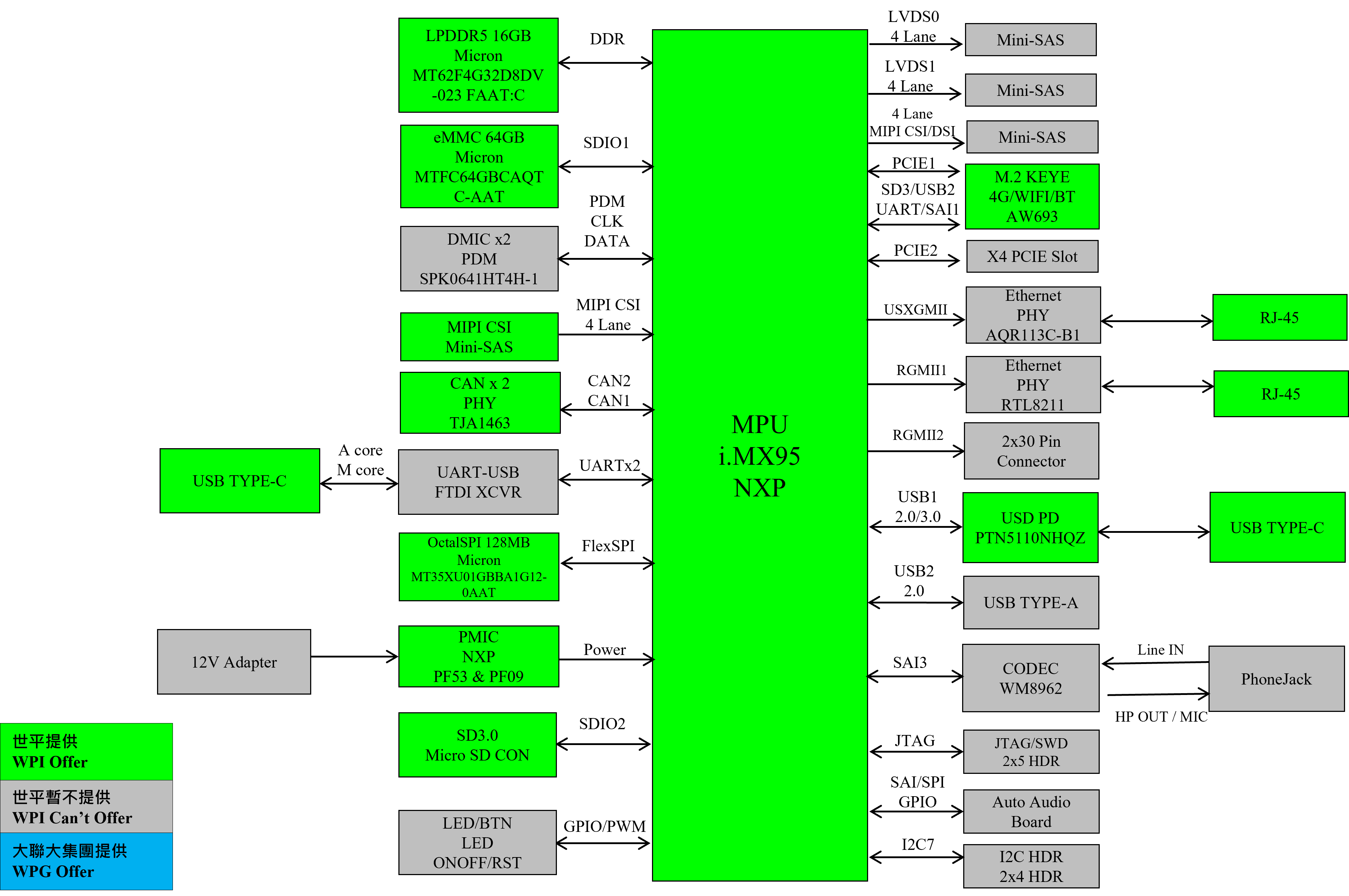
►方案方块图
►核心技术优势
◆ Equipped with the eIQ® Neutron Neural Processing Unit (NPU) with 2 TOPS of computing power, it delivers powerful machine learning inference capabilities. Compared to the widely known Graphics Processing Unit (GPU), it is more energy-efficient and offers higher performance, making it a processor specifically designed for deep learning and artificial intelligence applications!! ◆ Features an independent SOM development board design, paired with the powerful NXP i.MX 95 chipset, and allows flexible configuration of I/O interfaces based on requirements for use with the SOM. This flexibility enables developers to design hardware platforms tailored to specific application scenarios, fully leveraging the performance and functionality of the i.MX 95 chipset. ◆ Combined with the I/O development board, it provides comprehensive peripheral configurations, such as High-Definition Multimedia Interface (HDMI), Low-Voltage Differential Signaling (LVDS), Ethernet, Controller Area Network (CAN bus), Universal Asynchronous Receiver-Transmitter (UART), Universal Serial Bus interfaces (USB Type A/C), 3.5 mm headset audio jack, Camera Serial Interface (MIPI-CSI), Display Serial Interface (MIPI-DSI), and M.2 - PCIe 3.0 interface. ◆ Quickly get started with the eIQ / PyeIQ machine learning development environment, offering application examples for various deep learning frameworks such as TensorFlow, TensorFlow Lite, ONNX, Keras, and PyTorch.
►方案规格
MPU (NXP i.MX95, MX95LPD5EVK-19CM) Core Specifications: ◆ Powerful Hexa-core Arm Cortex-A55 processor up to 1.8 GHz ◆ eIQ® Neutron Neural Processing Unit operating at up to 2 TOPS ◆ Dual Image Signal Processors (ISP) with support for RGB-IR format ◆ Two MIPI-CSI Camera Interfaces for vision processing applications ◆ Robust 3D/2D graphic acceleration (Arm Mali-G310) ◆ High-performance video encoder and decoder supporting up to 4Kp60 frames (including JPEG, H.264, and H.265) ◆ High-definition display support: MIPI-DSI at 4Kp30 and LVDS at 1080p ◆ Built-in eMMC 5.1 with 64GB storage capacity ◆ Supports external memory with up to 6.4 GT/s data rate and a 32-bit interface for LPDDR5/LPDDR4X MPU (NXP i.MX95, MX95LPD5EVK-19CM) I/O Specifications: ◆ 1x 10GbE + 2x Gb Ethernet with TSN, AVB, and IEEE 1588 for synchronization ◆ 1x USB 3.0 Type-C with PHY + 1x USB 2.0 Type-C with PHY ◆ 5x CAN FD ◆ 8x UART, 8x I²C, 8x SPI, 2x I3C ◆ 1x 8-channel, 12-bit ADC ◆ 2x 32-pin FlexIO interfaces ◆ 2x PCIe Gen 3 with 1x lane